Cycle of Change » Safety
Cycle of Change: Safety
“I want to advocate for a safer transportation system for the Eugene-Springfield area soon enough to save lives.”

Currently, the CoC Safety group is organizing a response to a series of people driving killing people bicycling.
To get involved, subscribe to the [email protected] Google Group:
News Conference, Other Safety Events
On May 20, 2026, at Rosetta Place Park, BEST convened community members and City of Eugene leaders to honor those we’ve lost and to call for safe and welcoming streets for people from all walks of life. ASUO + GTFF installed signs along Patterson Street. Shift Community Cycles led a Celebration of Life Group Ride.
Community Forum
On February 12, 2026, at Roosevelt Middle School, BEST, GEARs, LTD, Shift Community Cycles, ASUO, GTFF, LiveMove, and UO Transportation Services organized an evening of connection, reflection, and discussion, looking to transform recent tragedies into collective work for a better future:
Local efforts
City of Eugene
- Vision Zero
- Plans & Resolutions
- Updated Vision Zero Action Plan (draft, Nov. 2025)
- Vision Zero Action Plan (adopted by Administrative Order No. 58-19-04, 3/29/19)
- Vision Zero Resolution (adopted 11/18/15)
- Studies
- Reports
- Newsletters
- Public Meetings & Events
- City Council Work Session: Vision Zero Update (4/15/26)
- Active Transportation Committee Meeting: Vision Zero Intersection Study (7/13/23)
- Vision Zero Celebration of Life (10/1/19)
- City Council Work Session: Vision Zero Update (4/10/19)
- Active Transportation Committee Meeting: Vision Zero Reporting App (11/8/18)
- Vision Zero Draft Action Plan and Open House (11/2/17)
- Active Transportation Committee: Draft Vision Zero Action Plan (10/12/17)
- City Council Work Session: Vision Zero and Safety (5/31/17)
- Active Transportation Committee: Vision Zero Update (5/11/17)
- City Council Work Session: Vision Zero Action Plan (5/10/17)
- Bicycle and Pedestrian Advisory Committee: Vision Zero Update (12/8/16)
- Bicycle and Pedestrian Advisory Committee: Vision Zero in Sweden and Denmark (11/10/16)
- International Walk + Bike to School Day (10/5/16)
- Bicycle and Pedestrian Advisory Committee: Vision Zero (8/11/16)
- City Council Work Session: Transportation Safety – Vision Zero and the Mayors’ Challenge for Safer People, Safer Streets (11/18/15)
- City Council Work Session: Transportation Safety – Vision Zero and the Mayors’ Challenge for Safer People, Safer Streets (9/30/15)
- Bicycle and Pedestrian Advisory Committee: Safety Action Plan/Vision Zero (5/14/15)
- Plans & Resolutions
Safety concepts
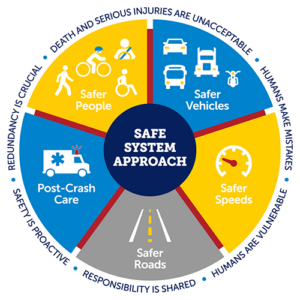
Safe System Approach
According to the U.S. Department of Transportation, a Safe System Approach incorporates the following principles:
- Death and Serious Injuries are Unacceptable: A Safe System Approach prioritizes the elimination of crashes that result in death and serious injuries.
- Humans Make Mistakes: People will inevitably make mistakes and decisions that can lead or contribute to crashes, but the transportation system can be designed and operated to accommodate certain types and levels of human mistakes, and avoid death and serious injuries when a crash occurs.
- Humans Are Vulnerable: Human bodies have physical limits for tolerating crash forces before death or serious injury occurs; therefore, it is critical to design and operate a transportation system that is human-centric and accommodates physical human vulnerabilities.
- Responsibility is Shared: All stakeholders—including government at all levels, industry, non-profit/advocacy, researchers, and the general public—are vital to preventing fatalities and serious injuries on our roadways.
- Safety is Proactive: Proactive tools should be used to identify and address safety issues in the transportation system, rather than waiting for crashes to occur and reacting afterwards.
- Redundancy is Crucial: Reducing risks requires that all parts of the transportation system be strengthened, so that if one part fails, the other parts still protect people.
Vision Zero
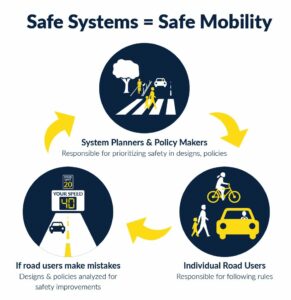
According to the Vision Zero Network, Vision Zero is a strategy to eliminate all traffic fatalities and severe injuries, while increasing safe, healthy, equitable mobility for all. First implemented in Sweden in the 1990s, Vision Zero has proved successful across Europe—and now it’s gaining momentum in major American cities. Vision Zero is a significant departure from the status quo in two major ways:
- Vision Zero recognizes that people will sometimes make mistakes, so the road system and related policies should be designed to ensure those inevitable mistakes do not result in severe injuries or fatalities. This means that system designers and policymakers are expected to improve the roadway environment, policies (such as speed management), and other related systems to lessen the severity of crashes.
- Vision Zero is a multidisciplinary approach, bringing together diverse and necessary stakeholders to address this complex problem. In the past, meaningful, cross-disciplinary collaboration among local traffic planners and engineers, policymakers, and public health professionals has not been the norm. Vision Zero acknowledges that many factors contribute to safe mobility—including roadway design, speeds, behaviors, technology, and policies—and sets clear goals to achieve the shared goal of zero fatalities and severe injuries.
Six E’s
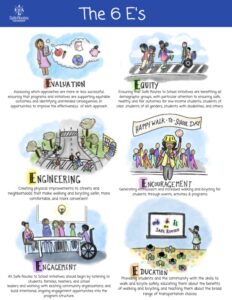
According to the Safe Routes Partnership, the Six E’s of Safe Routes to School include:
- Engagement: All Safe Routes to School initiatives should begin by listening to students, families, teachers, and school leaders and working with existing community organizations, and build intentional, ongoing engagement opportunities into the program structure.
- Equity: Ensuring that Safe Routes to School initiatives are benefiting all demographic groups, with particular attention to ensuring safe, healthy, and fair outcomes for low-income students, students of color, students of all genders, students with disabilities, and others.
- Engineering: Creating physical improvements to streets and neighborhoods that make walking and bicycling safer, more comfortable, and more convenient.
- Encouragement: Generating enthusiasm and increased walking and bicycling for students through events, activities, and programs.
- Education: Providing students and the community with the skills to walk and bicycle safely, educating them about benefits of walking and bicycling, and teaching them about the broad range of transportation choices.
- Evaluation: Assessing which approaches are more or less successful, ensuring that programs and initiatives are supporting equitable outcomes, and identifying unintended consequences or opportunities to improve the effectiveness of each approach.
Dangerous by Design
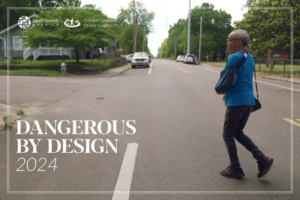
According to Smart Growth America, our nation’s streets are dangerous by design, designed primarily to move cars quickly at the expense of keeping everyone safe. Unfortunately, this crisis will continue to get worse until those in power finally make safety for everyone who uses our roads a top priority.
Safety Over Speed
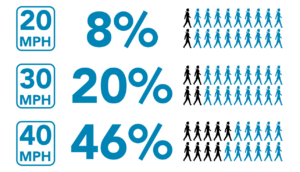
According to the Vision Zero Network, more than one-third of fatal crashes are speeding related. The most significant way to prevent traffic deaths and severe injuries is to manage speed for safety.
Rethinking Streets
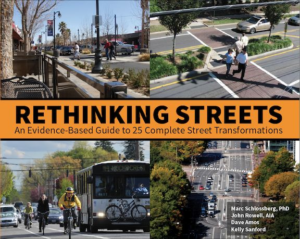
According to a research team with the Sustainable Cities Institute at the University of Oregon, for too long we’ve been building streets as though they have one function: to move cars quickly. The reality is that streets can to do more than just move cars. They can move people on foot, on bikes, on transit, without hurting vehicular throughput and safety. They can be more than a way to get somewhere else. Good streets are good places, too: public places where people meet, sit and socialize, conduct business, wander about, play, and more. Their series of books uses evidence from completed street projects from around the United States in order to help communities imagine alternative futures for their streets.
Crash Not Accident
According to the Michigan Department of Transportation, safety starts with all of us. Whether you drive, ride, walk, or bike—everyone deserves to get home safe.
One simple step is changing how we think and talk about crashes. Words matter. They shape how we act on the road.
Merriam-Webster defines an accident as “an unfortunate event resulting especially from carelessness or ignorance” and a crash as “a breaking to pieces by or as if by collision.” These words are not the same, yet they are often used interchangeably.
Calling a crash an “accident” suggests no one is at fault. In reality, crashes result from preventable actions like distraction, inattention, or risky driving.
Traffic crashes are NOT accidents. Let’s stop using the word “accident” today.
- Crash Not Accident
- Crash Not Accident (Michigan DOT)
- Replacement of Accident with Crash Terminology (California DOT)
- Strategic Highway Safety Plan (Caltrans)

Further reading
- Why Are U.S. Traffic Deaths Increasing Again? (New York Times, 3/18/26)
See also
Related information from BEST:
Last updated 6/10/26.